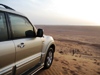
الله يخلي الاختبارات بس :D <---مسوي يذاكر هو ووجهه :p
ان شاء الله مره ثانيه...
اجيك بالتاهو يا ابو انس :D
الله يجمعكم على طاعته :)
تحياتي...
والله يحزنو اصحاب الدراسة ..... مساكين
|544|
اتعبو زي ما تعبنا ....
امزح بس والله يوفقكم ,, والجيات اكثر والبر موجود طول السنة
عرف انكم خبيرين في القيادة على الكثبان الرملية (الطعوس) ,, لكن اسمحولي اقتبس جزء من التعليمات عن القيادة في الكثبان اعطت لي في رحلة تدريبية للقيادة في الكثبان الرملية مع نادي اوف رود اجنبي ,, النص للاسف بالانجليزي , لكن ساحاول ترجمة ما اراه مهم جدا , وكذالك اتمنى من الزملاء اللذين يجيودن اللغة مساعدتي
Vehicle preparation
Vehicles must be in roadworthy condition. Especially important are suspension and clutch conditions. Sand driving in general, and dune driving in particular, stresses these components more than any other driving.
Know the range of your vehicle on a tank of gas. You will get much less mileage in sand. Make sure that oil and all other fluids are topped up. In light of the high revving and high ambient temperatures, oil burning and coolant loss may be significantly higher than road driving. Bring an extra litre or two of oil, as well as radiator coolant and/or sufficient water to refill your radiator (4 to 6 litres). Failure of either engine or cooling system will not only strand you, it will ruin everyone else’s day, and force them to tow or assist you. While we are glad to assist in case of unforeseen accidents, failure to come prepared will elicit little sympathy.
Know where your jack is stowed, how to operate it, and how to get at your spare. Have a piece of solid wood handy to keep your jack from sinking into the sand. Make sure your spare is in good condition. Flats are surprisingly common in sand: a small sharp rock can easily slash a deflated tire. The type of tire damage is usually way beyond anything that can be repaired by spray sealant or tubeless tire repair kits.
Devise a method for strapping everything down – bungees, nets, whatever.
Convoy Etiquette
The driver in-front watches out for the car behind. If the car behind cannot be seen, the driver should stop. This will ripple forward, to the point where the leader will loose sight of the car behind them and turn back until the car in trouble is reached.
Equipment requirements
You will get stuck, and you will be expected to assist others who get stuck, usually several times a day. Sand driving thus requires a minimum investment in equipment: By far the most useful item you will need is a shovel. While bigger is better, even the folding army trowels are better than nothing. Get an air compressor and figure out how to use it. The gauges on compressors can be unreliable, so get a good tire pressure gauge, and know the recommended tire pressures for your particular vehicle. They will be written on a doorjamb or in the owners’ manual. If you don’t have these items, you are not ready for dune driving, period.
Optional items, if you decide to make a habit of dune driving: a snatch strap, also known as kinetic rope (a special kind of tow strap with elastic properties – designed specifically to pull vehicles out of sand and mud), and is a must-have item. The design of the strap and the tow hook arrangement on your vehicle might require you to get shackles as well. Snatching is by far the preferred extraction strategy, and beats digging by a long shot.
Sand ladders: a set of 4 steel racks designed to provide enough traction to get unstuck. The design is so simple you can weld them up yourself or have someone do it for you at little cost. With shovel and sandladders, you can pretty well dig yourself out of anything alone, but it will not be easy…
While not specifically related to vehicles or equipment, the following items are good to have in the desert anyway: goggles to protect against blowing sand; work gloves to protect hands from very hot ****l; boots to keep out the hot sand. Sandals are not recommended, although they are blessedly cool. You will be expected to physically assist others and improper footwear = poor footing = injury.
Fundamentals of sand driving
Sand driving:
The primary principle of sand driving is to remain on top of the sand.
Do this by:
Rule 1: Deflate your tires. 18 lbs or 2kgs should suffice although you can go as low as 13 -15 lbs in case of extremely soft sand. This increases your contact patch, by extending the amount of tyre in touch with the sand, and helps you “float” on the sand. Deflating lower than that recommended above and you risk the tyre slipping on the rim and/or losing air along the bead. Deflating increases the risk of sidewall slashing/puncture: watch out for rocks. You will have to inflate before going back on the road: have a compressor and know how to use it.
Rule 2: Stop carefully. Try to roll to an as gentle a stop as possible. Do not slam on your brakes. This rule pre-supposes that you are keeping a good distance between you and the car in front of you. Whenever possible, stop pointing downhill. That little extra pull of gravity can keep you from bogging down. For cars fitted-out with ABS, braking gently is basically forced by the car. You may experience that ABS, under certain circumstances (e.g. on the crest of a dune), is not a nice assist to have.
Rule 3: Make fresh tracks. New sand offers more support than churned-up sand. Avoid driving right in the tracks of truck in front of you. A tire width to one side or the other can make a big difference.
Rule 4: Don’t drive too close to anyone, even a stopped vehicle. Sand slows steering reactions and can cause you to slew into them, or get stuck so close that you cannot be extracted safely. Give everything and everyone a wide berth – at least a car length.
Terrain recognition
For this you just have to get out in sand a lot and get the feel of your vehicle. You have to judge where you will go, what effect it will have on your vehicle and what problems are likely to crop up on your path. Try to recognize and avoid soft sand: in the base of bowls, at the leeward foot of dunes. Look for changes in colour, consistency, surface pattern of sand.
Avoid clumps of grass – they can be quite hard. As the sun rises, all contrast disappears, making it very difficult to see bumps, bowls, cliffs etc. If the surface changes suddenly – be ready to react. Be aware of the distance and where you are going and concentrate on the area nearby and where your wheels are going to go.
The primary dangers of dune driving are rolling and nose-diving. Basically, you want to keep your vehicle as level from side-to-side as possible, and keep all four wheels on the ground.
Know the angles of approach and departure of your vehicle. These angles will determine if you plow your radiator into the sand when you climb a dune, or rip off your rear bumper on the descent.
Analyse your intended path: what is the condition of the sand? Will you be climbing/descending/traversing? What is on the other side? Where are you most likely to get stuck? Choose a path that is comfortable for you. You are ultimately responsible for your vehicle and everyone in it. Do not hesitate to go around if you are nervous about going over.
Dunes
Skiers will quickly get the feel for dune driving. The physics are similar.
Dunes have an easy windward side, where blowing sand has built up a smooth ramp, and a steep leeward side, where the sand drops off steeply. But only to a maximum of 52 degrees, which any self-respecting 4x4 can descend with ease. Dunes are frequently curved, and the bowls within the curve of a dune are notoriously soft and should be avoided.
Traversing dunes (or Half-pipe)
Again, skiers, mainly snowboarders, will instantly recognise the technique.
This technique is for driving parallel with the line of the dunes. Approaching the end of a dune from its windward side allows you to smoothly climb the slope on an angle towards the top, then turning down to swoop to the next dune. If the dunes are symmetrical, you can slalom along them for quite a distance.
Watch out for dunes that are steep! Traversing the face of a steep dune can cause you to roll. Do not stop while traversing a dune – wait until you have begun your descent. If you feel like you might tip, turn downhill as soon and as smoothly as possible.
Ascent
This technique is for crossing dunes. The rule is to approach the dune straight on at a 90 degree angle. Pay attention to the angle of approach (where the level desert floor meets the foot of the dune– too steep and it will be like running into a wall). You should climb the dune at a steady pace (don’t change gears halfway up), easing off the gas just as you crest the dune, allowing your momentum to carry you over. This will keep you from going airborne and nose-diving into the desert on the far side of the dune. Nose-diving will seriously damage your 4x4 and probably injure you. It is to be avoided at all cost! Depending on the horsepower of your truck, you may be able to climb quite steep or long dunes. Underpowered trucks either have to drive faster, significantly increasing the chance of launching off the other side, or will bog down part way up the dune and have to roll back down, or just give up and go around. Know your vehicle’s limits. Do not try to climb the leeward (steepest side of dunes) Sand can hold itself up to a maximum of 52 degrees. Most trucks can only manage to climb 30 or 40 degree inclines.
Cresting
Ideally, you will just coast over the top of the dune, using your momentum to tip your nose over the edge enough for gravity to take over on the descent. Too little speed and you will bottom out on the crest of the dune. Too much speed and you will launch into space with possibly disastrous results.
It will take several tries (dozens?), before you get the speed/angle combination just right. Even experienced dune busters get stranded while cresting dunes. Its part of the fun…
If you get stuck on the crest, you will need to be pulled down, either forwards or backwards depending on the lay of the land. Digging and sandladders are of little use, as your suspension will be hanging down with virtually no weight on the tires. An air jack under the rear axle can sometimes tip you over the crest.
Descent
Having driven up the dune, you are now committed to going down the other side.
You will have a moment of panic (ecstasy?) as you crest the dune, because all you will see is sky. Then, as the vehicle weight transfers to the front wheels again, you will begin your descent. Make sure you are going down the dune at a 90 degree angle to the slope – correct gently as needed, as it takes sometime for change to occur in sand and it is easy to over-steer.
With the truck in first gear, take your foot off the gas and let the truck idle down the dune. Be prepared to brake very gently if you start picking up speed. Do not accelerate. Always control your (slow!) speed.
The sand will form a “bow wave” in front of your vehicle, slowing you to a consistent speed, regardless of the length or steepness of the dune. No matter how steep it looks, sand can only manage 52 degrees. In fact, if you brake to a gentle stop in mid-descent, your 4x4 will just sit there…
Do not try to radically change direction while you are descending. This may cause you to slew and roll.
If you are unsure of the “lay” of the dune face you will descend, get out of the truck, climb up the dune and check it out: choose the path and angle of ascent, the point where you will crest. These will pretty much determine where you will descend.
Pay attention to the angle of departure (where your truck transitions from the nose-down descent position to level driving). A steep angle can cause you to actually run nose first into the desert floor, and/or drag your bumper, possibly damaging it.
Bowls
These may look inviting, but they should be avoided: they are usually full of soft sand (actually, these are often dust filled), and make towing very difficult. Use the dune traversing technique to drive around the wall of the bowl (The Wall of Death technique), rather than going down into them. If you must cross a bowl, try to get your speed up to carry you over any soft sand and up the far side. Do not shift gears or brake until you crest the opposite side.
Dips and Rollers
While a shallow dip may appear innocuous enough, it can really cause your truck’s back end to buck if you are going fast. Rollers are a series of dips and humps. Your truck can really start to buck going over these, causing loss of control. Be sure to have everything in your truck strapped down, people included. Keep your speed reasonable for the terrain.